.webp)
Alumni in Employee Referral Programs
Why alumni?
John Sullivan, an HR consultant whom 'Business Insider' dubbed 'the Michael Jordan of recruitment', once coined the phrase: "don't hire strangers". It was a call to reduce the information asymmetry between employer and candidate, which by its very nature leads to misunderstandings and, consequently, disappointments.
A candidate who does not know a company well may have a weak or downright mistaken idea of its organisational culture, working conditions or expectations towards employees. An employer who knows a candidate only from a CV and a job interview may likewise be unaware that the potential employee is a poor cultural or motivational fit for the new role and workplace.
To avoid this, Sullivan advises filling vacancies with –
- candidates referred by current employees, since the latter know both the organisation and the person applying for the job, and know things about them that you will not find in employer branding communications or a polished CV
- alumni, that is former employees, who by definition know what kind of organisation and what expectations of themselves they will be dealing with
Then, synthesising these two recommendations as it were, Sullivan proposed a third solution: boomerang referrals.
The idea is very simple: the organisation's task is to keep alumni in its orbit through skilful communication and a value proposition (mailings, text messages, events, benefits), so that they form an important component of the company's talent community. We then encourage these former employees to consider returning to our company (boomerang hire) or to recommend a friend for a job – from the pool of other former employees or from outside it (boomerang referral).
Why are referrals made by alumni so valuable? The most important reasons can be listed as the 3 C's: credibility, knowledge (competence of insight), and connection.
- Credibility. Changing jobs is one of the more important decisions we make in life. As with any key choice, people have an understandable tendency to place trust in the recommendations of family and friends, that is, people they trust. An alumnus, having a relationship with the candidate, will therefore be a more effective "carrier" of the employer's branding communication than any advertisement. At the same time, an alumnus is particularly credible as a referrer: they no longer work at the organisation, yet they still recommend it; this means they must have genuinely good memories associated with it.
- Knowledge. A former employee knows the company inside out: they are familiar with the pay, benefits, organisational culture, quality of workplace relationships, the type of tasks performed in a given role and a thousand smaller but significant things that can only be learned by working at a given company. At the same time, they know the candidate, so they know whether the person is serious about the job, whether they have a mortgage and a family to support, whether they see their future in a given city, whether the dress code will chafe, whether they will get along with the new manager, and so on. The alumnus-referrer removes, for all participants in the process, the problem of two-way information asymmetry, making the employer and candidate take more informed decisions – and therefore ones with a better prognosis for the future, understood in terms of productivity and retention.
- Connection. Referrals are based on relationships in a triangle: employer-referrer-candidate. It is a fairly complex relationship, because referrers are not only employees, current or former, but also trainees, interns, contractors, candidates for other positions, and so on. Furthermore, today's candidate is often tomorrow's referrer (every good referral program m u s t collect referrals from people who are in onboarding), and it also happens that today's alumnus-referrer will tomorrow be a candidate themselves (re-hiring). A referral program, however, strengthens bonds not only between the referrer and the candidate, but also between the organisation and the alumnus. It gives them a concrete task and a concrete, usually financial, benefit. It allows the company to say that it values the alumnus's opinion and contribution, letting them co-shape its HR policy. It gives them an impulse to register in the company's referral program, and gives the company a reason (and the ticked GDPR consents) to reach out to them with engaging communication – via email, phone, or events.
How does it work?
Clariant, a Swiss chemical group, operates and recruits in Poland in two main areas: production and Global Business Services – Shared Service Center (GBS / SSC). It was mainly with its Shared Services Centre in Łódź in mind that the company decided to launch a referral recruitment program whose distinguishing feature is a module dedicated to engaging alumni.
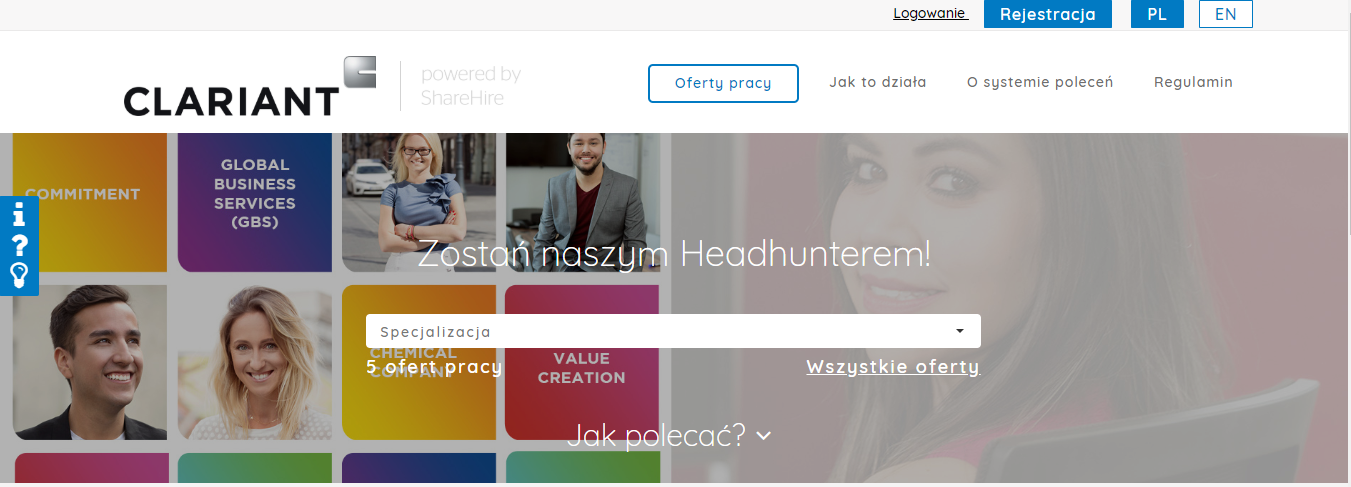
"In May we launched CLARIANT CLUB" – says Agnieszka Stępień, HR Advisor at Clariant – "a program aimed at bringing together the community of our former employees by creating a platform for contact and exchanging information about the current situation of our company. Thanks to membership in CLARIANT CLUB, Alumni will receive information about Clariant, updates on the company's status and development plans. They will be informed about campaigns and events in which Clariant participates and have the opportunity to meet us during numerous employer branding initiatives and events. In addition, they will join our external referral program run via ShareHire, because who can be a better ambassador than people who work or have worked at the company? The answer is simple: no one other than our current and former employees is the most credible source of information about Clariant, our work culture and values."
Alumni take part in the program at the employer's invitation, which they receive by email. The message is written so that the former employee immediately learns the idea of referrals, the program rules and the available rewards. If they are interested in participating, they must fill in a short registration form (first name, last name, email, setting a password) and tick the box "I am a former Clariant employee and I want to join Clariant Club".
The system administrator is automatically notified of a new application, and their role is to verify the employment history. If the user really is a former employee, the administrator grants them access to the referral program with a single click. Then, as in any other referral program delivered by ShareHire, the user can refer friends for job offers published by the employer by sharing referral links with candidates. Successful recommendations come with financial rewards. The system's architecture allows an alumnus to receive higher rewards than, for example, an external referrer, that is, a person not connected with the company. Information on whether the user will receive a reward, as well as notifications about the publication of new job offers, contests, etc., is sent automatically to the email address provided during registration in the system.
Mailing, however, is not the only method of Clariant's communication with alumni. The company builds engagement and attracts former employees through, among other things, organising events such as the Łódź music event "Festival of Colours", open-air film screenings, or open meetings dedicated to the referral program, during which an alumnus – but potentially also an external referrer – can learn how to recommend friends effectively.
Clariant's referral system, which also covers alumni, operates based on technology and legal solutions provided by ShareHire. "Deep automation and an intuitive interface make operating the referral system by ShareHire very simple and convenient" – adds Agnieszka Stępień. "Moreover, data administration, reward payouts, drafting the terms and conditions, user support – all of this lies on ShareHire's side, not ours – which significantly relieves our recruitment team of administering the external referral system, not only at the beginning of its operation, but throughout the entire course of our activities."