.webp)
Talent Community
What is a talent community?
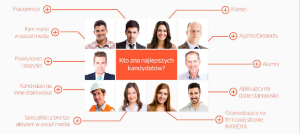
A talent community is a group of people who gather around our brand to participate in our recruitment projects as candidates, referrers, or ambassadors. It is not just a candidate database. It is a living community that should identify with our brand values and respond positively to the value proposition it offers.
Recruitment in the age of digital communities
We live in the age of digital communities. The company that provides the most rides doesn't own a single taxi. The company with the most overnight stays doesn't own any hotels. The main source of the content we consume daily comes from media outlets that don't employ a single journalist. The social revolution has not bypassed HR and recruitment. To see this for yourself, just look at what is happening overseas.
Examples of modern recruitment solutions
Careerify mobilizes company employees to become headhunters and provide their employers with valuable candidates in exchange for rewards. Recruitloop gathers a community of professional recruiters who can use the platform to engage with clients as freelancers. RolePoint goes even further, inviting both professionals and amateurs, employees and those not directly associated with the company, to refer friends in exchange for attractive incentives. In the Polish market, ShareHire.pl implements a model similar to RolePoint. BountyJobs finds its equivalent in the domestic HRfactory.pl.
Community as a resource
All these solutions have one thing in common: they recognize the community as a valuable resource. Perhaps even the most valuable, as it is impossible to copy, self-sustaining, and provides a powerful return on investment with minimal effort. Recruiting through a community allows us to tap into the networks of hundreds or even thousands of people. Everyone reached by such an occasional recruiter with information about a job opening not only gets the chance to see the offer but also receives a clear message: their friend believes we are an employer worth recommending.
Benefits for both sides
The terms under which we engage the community are generally convenient for both parties. The company pays for results (hiring), and the community recruiter refers when and whom they want, without much effort. Recommending an employee via the ShareHire.pl system takes 40 seconds and can be worth several thousand zlotys.
Problems with traditional recruitment
Although the need to adapt to the realities of Web 2.0 seems obvious, most companies are still stuck in an outdated model of one-way communication. According to Ascendify data, as many as 90% of visitors to company career pages do not apply or leave their email address to stay in touch. Even assuming these figures are exaggerated, it is undeniable that the vast majority of internet users slip through recruiters' fingers. In principle, this should not surprise us. Most companies give visitors to their site no reason to want to maintain a relationship with them. Potential candidates are offered neither interesting information, nor a chance to engage, nor entertainment. Usually, they have to settle for a handful of dry facts (yes, "you'll get a Multisport card") and tired slogans ("join a team of young, dynamically developing industry leaders..."). In the Web 2.0 era, that is not enough.
Building a talent community
A modern employer should aim to consciously build a real talent community consisting of employees, interns and trainees, alumni, candidates, and people who interact with their brand on social media. Their task is to do what Uber or Airbnb are already doing: turn the community gathered around their brand into a resource, a significant factor in creating a competitive advantage.
Leader and brand vision
How can this be achieved? First and foremost, we must be a brand worth gathering around. Every community needs a leader to set the direction. The vision of a career path in our company must be appealing and inspiring. If we are not supported by a charismatic CEO or a talented community manager, the brand itself must become the leader of the community.
A place for meetings and interaction
Furthermore, we need a meeting place. If people are to exchange thoughts, share content, and make recruitment referrals, they need a place to do so. Therefore, a dedicated section of the website—or an entire community system—that takes on this role is essential. This is exactly what applications like RolePoint or ShareHire.pl do.
Value proposition for the community
Last but not least, a value proposition is essential. The community must feel that they are the beneficiaries of the arrangement we are proposing. If we ask internet users to share an idea, fill out a survey, or look for job candidates among their friends, we must offer a reward in return. It can be financial, material, or symbolic, but it must be a genuine expression of gratitude and appreciation. Another type of value we can offer is knowledge.
Examples of employer branding activities
PwC Hungary created a game that allowed anyone to see what a workday looks like at a Big Four firm. Hungarian users solved cases, analyzed data, and learned not only how to compete but also how to collaborate with other participants. This gave them solid preparation for a job interview. They now knew where their gaps were, recognized their strengths, and learned whether a career in consulting was what they had imagined when leaving business school.
Their competitor, Deloitte, decided to create a dedicated website exclusively for students and interns in New Zealand. This specific community requires appropriately calibrated communication. The premise was simple: who knows the language, tastes, and concerns of Generation Y better than someone who is a member of it themselves? Therefore, Deloitte handed the site over to its interns and trainees. Their task was to create light yet practical content and engage young people in conversation.
Those who visited the Deloitte Grads and Interns Facebook page were to be convinced that it was worth becoming a brand ambassador. The project management team answered their questions and accepted suggestions. They also showed what it’s like to work at the company "behind the scenes." They constantly provided specific calls to action: come to a meeting, join us for a charity cause, or submit your application for a new internship program. Interaction with the brand, both online and offline, was enjoyable because it involved contact with peers and provided initial professional experience. Students were eager to share valuable content, especially multimedia. In this way, they ensured exposure for the Deloitte brand on social media. Through selfies, hashtags, or blog posts, they created content themselves that helped position the employer in the eyes of twenty-somethings.
The Dell community
Dell, in turn, decided to engage its community in referring others for work. Every successful referral comes with a reward. Interestingly, the company focused its communication on the non-monetary aspect of the matter. In their promotional materials, we see, for example, John, who used the funds he received to fulfill his dream of taking flying lessons. The elegant (and branded) message ends with the question: "what will you do with your reward?" This likely makes many people wonder why they haven't joined the company's talent community yet.
The concentric circles model in recruitment
The American company adapted its entire recruitment strategy to a community model. We can imagine its talent community as concentric circles. At the center are employees, so recruiters are expected to "prioritize" resumes coming from internal recruitment. Next are resumes from people referred by employees. Then, individuals from non-employee recommendations. Someone from outside the community ends up at the very end of the line.
The key: engagement
The method of reaching people varies. The communities that gather around brands are also different and unique. However, the common denominator remains the same: engagement. The key to acquiring applications, referrals, ideas, or likes is the ability to attract people and maintain their interest through engagement. A standard Careers page is not enough here.