.webp)
More candidates at a lower cost. How applying via SMS works
A candidate-driven market and the competition for talent
A candidate-driven market forces tougher competition for talent. Securing effective tools for candidate acquisition is currently becoming more urgent than candidate selection. Among these, applying via SMS stands out for its efficiency and simplicity.
The return of SMS in recruitment
Text messages, at least in the recruitment sector, are making a comeback. Overseas, it is even said that in this industry, "SMS is the new email." The ability to apply for a job via SMS means we spare the candidate from having to fill out forms, click through websites, or track job boards. This solution works especially well where there is a need for staff in entry-level positions, where candidates' familiarity with and access to online tools are not guaranteed, and where a simple SMS can improve reach within the target group.
Example: Applying via SMS
Imagine this situation: a warehouse worker (let's call him Tom) is heading home after a hard day's work on a bus or any other form of public transport. He is tired—not just from lifting boxes, but also from waiting for a raise and dealing with a difficult manager. He is thinking about a change. Suddenly, he sees a poster on the window presenting an offer from a competing company. He sees a brand that inspires trust, smiling employees, but above all, a short yet tempting message about better pay, work organization, and benefits. At the bottom, there is a simple call to action: "Send an SMS to the number below with the word 'Apply'. We will call you and tell you what offer we have for you."
A simple application as the key to success
So, a phone and an SMS instead of, say, a website and a Careers page. That suits him. Tom doesn't have a smartphone or a mobile internet connection. He doesn't follow job postings on portals and doesn't like social media. He also doesn't want to call any hotlines. But sending an SMS takes him 10 seconds. He immediately receives a notification thanking him for his application and informing him that the company will contact him soon. The next day, a recruiter calls him during a standard candidate screening. They agree on the terms, working hours, and salary. From the following week, Tom starts a new job.
Conclusions for employers
What are the takeaways for employers? It pays to make life easier for the candidate. The SMS system allows them to apply spontaneously and without unnecessary formalities. We have their attention for a few seconds—and that is enough.
A simple application process via SMS
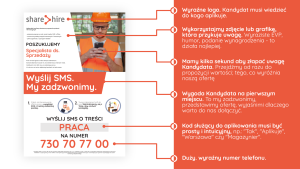
This, in turn, means that explaining the SMS application process must be as simple as the process itself. The poster we would use to convince Tom to submit an SMS application should look like this: Although the message should be adapted to the company's marketing standards, its specific identity, and its needs, certain best practices are universal.
SMS as a way to acquire candidates
For comparison, let's imagine Anna, who works in customer service for a well-known logistics brand. She is happy with her job. But, walking past a competitor's headquarters this morning, she saw information about development opportunities that her current employer doesn't offer. She isn't sure if it's time for a change, but since all it takes is 10 seconds to send an SMS, she is happy to learn the details of the offer. In this way, we gain a recruitment lead for someone who is hesitant—decisive enough to allow contact, but still far from submitting a CV. A well-conducted conversation can convince her to accept our offer.
Benefits of SMS applications
An SMS package and printing posters don't cost much, yet they create incredible opportunities to reach candidates. It is worth launching this source of quick applications before the competition does.